Holiday Family Togetherness
Kwanzaa Greeting & Gathering Pack
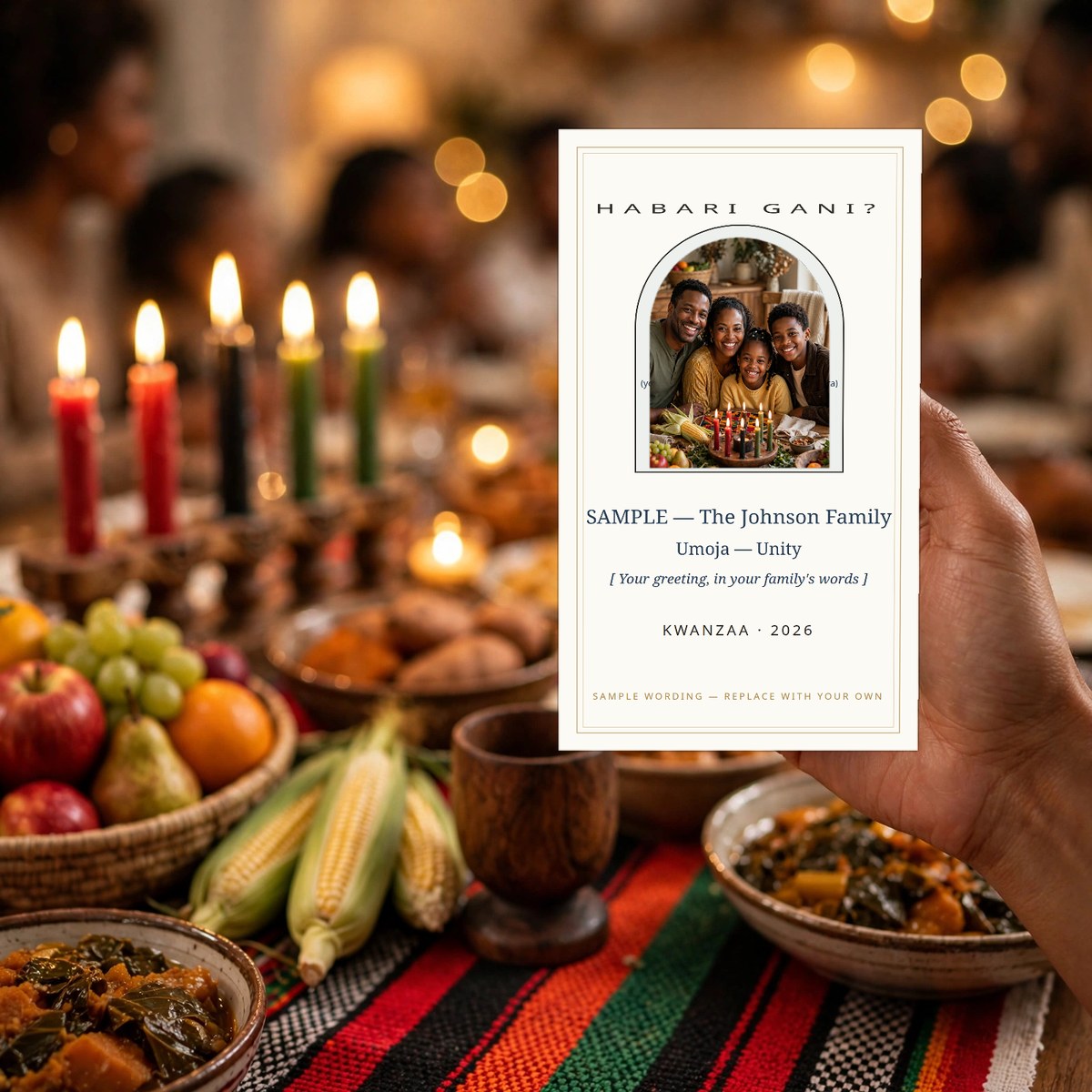
The suite, as it arrives — cover first, then the cards in the order you will send them. Tap any card to read it at full size.
The video announcement
Watch it arrive.
The suite’s video, as it arrives in the family chat — a sample photo and sample words throughout. In the one you send, your family’s photo and words take their place.
Habari Gani? Seven days, seven principles — and the family gathered around every one.
Kwanzaa is a cultural celebration created in 1966 by Dr. Maulana Karenga: seven days, December 26 to January 1, each day given to one of the Nguzo Saba — Umoja (Unity), Kujichagulia (Self-Determination), Ujima (Collective Work and Responsibility), Ujamaa (Cooperative Economics), Nia (Purpose), Kuumba (Creativity), and Imani (Faith) — closing with the Karamu feast. This pack holds the whole arc: a greeting that can travel across the seven days, the invitation to your family's gathering and Karamu, a card for the family joining by video, the thank-you after, and a keepsake of this year's celebration.
The principles are carried in words, never turned into decoration. Each day's greeting card names that day's principle in Swahili and English, the way families greet each other — "Habari Gani?" answered with the principle of the day. The symbols of Kwanzaa — the kinara, the mishumaa saba, the mkeka, the mazao, the muhindi, the kikombe cha umoja, the zawadi — belong on your family's table, in your family's hands. They are named in the guide as the things your family sets out; they are never drawn here as clip-art. Your photos carry them, because yours are the real ones.
Kwanzaa is a cultural celebration, held by families of many faiths and none. Nothing in this pack assigns it a religion, and nothing borrows another holiday's symbols or words. Families who also keep Christmas, or another observance, keep it separately — each in its own register, side by side if your family holds both.
Every family shape, at the same table. One parent or two, grandparents at the head of the table, blended families, chosen family, family on a screen from another time zone — host lines and family lines are fields your family fills, and the principles' own language of unity is the family's to speak, not ours to script.
The edit guide also holds one quiet option: a remembrance element for the elder — or the one — who isn't at the table this year, present in the keepsake in your family's own words. Offered there only, never printed by default.
What you receive
- Greeting card — your family's photo, your greeting in your words, the year. Made to send on the first day — or across all seven, one principle at a time. Phone size (1080×1920) + print 5×7.
- Gathering invitation card — your family's Kwanzaa gathering or Karamu: the day and its principle, time, place, RSVP name and number, in the same design.
- Far-away card — a screen-moment card for family joining by video: the time written in both time zones, sent ahead so they are part of the table, not an afterthought.
- Thank-you card — for hosts, guests, and gift-givers, ready when you are.
- Keepsake card — this year's photo, the seven principles named, and a line in your family's words.
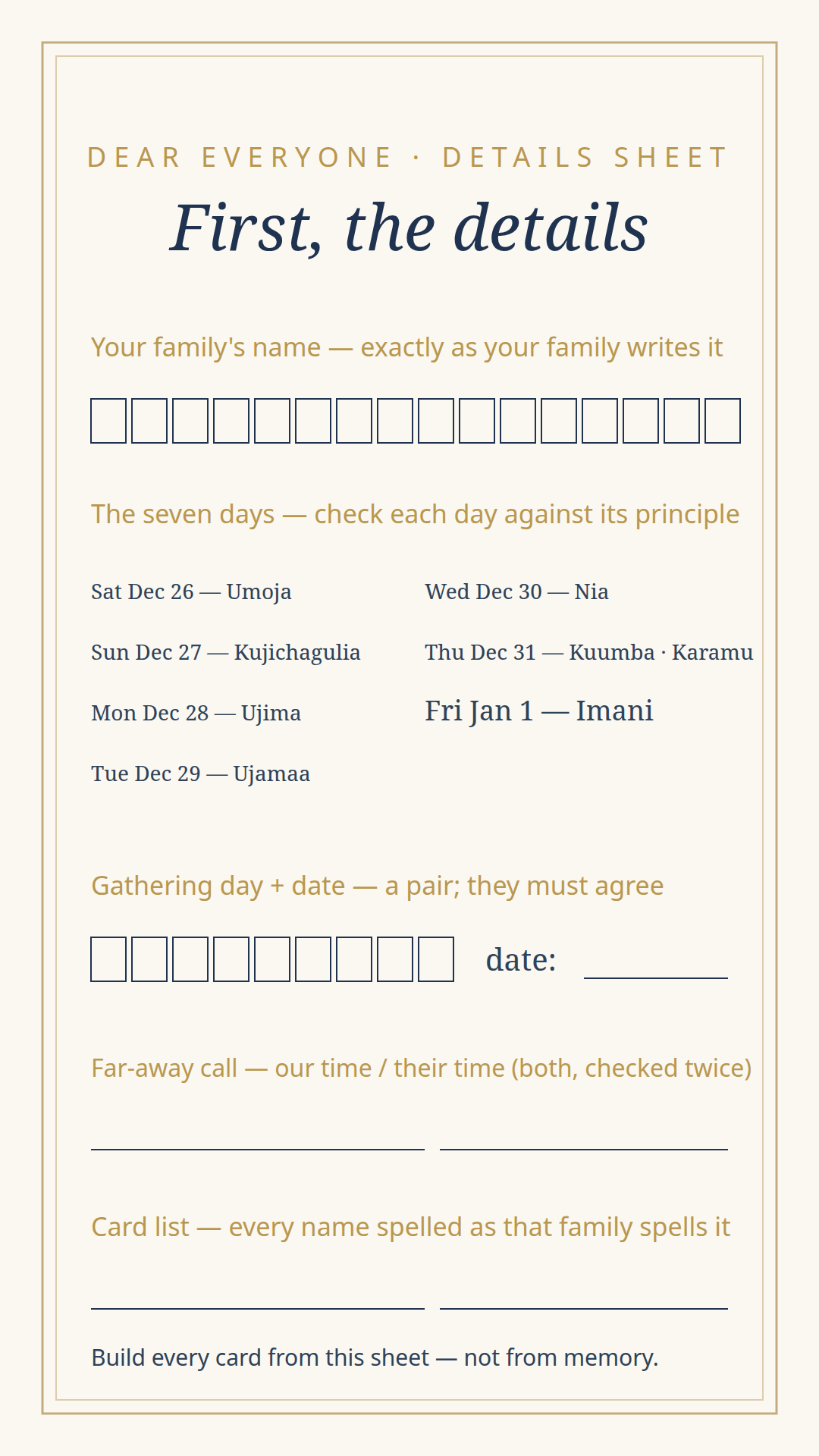
- Details sheet — the family name and greeting written once; the seven days laid out with their principles and dates checked; the gathering day confirmed as a day-date pair, before you build a single card.
- Video greeting (MP4, ~14 seconds) — a warm vertical video of the greeting card, made for family chats and Stories.
- Layered source files (SVG) — every word editable in free tools.
- Simple edit guide — short numbered steps, written to do in sittings, with the seven-days plan, the symbols named for your own table, photo-consent and address-privacy notes, and the full before-you-send check.
This is a digital product — no physical item is shipped.
The details sheet
Write it once. Check it here. Never from memory.
Every name and date goes on this sheet first, in letter boxes, with the weekday checked against the date — before a single card is built. Precision is a form of love, so we made it part of the suite.
Questions, answered plainly
Are the seven principles on the cards?
Yes — carried in words, as families use them: each day's greeting names the day's principle in Swahili and English, and the keepsake names all seven. What we never do is draw the symbols of Kwanzaa as decoration; the kinara on your table, in your photo, is the real one.
Is this a religious pack?
No. Kwanzaa is a cultural celebration, created by Dr. Maulana Karenga in 1966, and families of many faiths — and none — observe it. This pack assigns it no religion and borrows no other holiday's language.
Can one card really span seven days?
Yes — the guide shows both patterns: one greeting on December 26, or the same card sent daily with the day's principle and one line changed. The details sheet lays out all seven days so no card goes out under the wrong principle.
When is the Karamu?
The communal feast is traditionally held on December 31, the sixth day (Kuumba) — many families also gather on other days of the week. The invitation holds any day your family gathers; the guide notes the tradition and leaves the day to you.
What does "Habari Gani" mean?
"What's the news?" — the traditional greeting of the season, answered with the principle of the day. It appears in this pack the way families use it: as a greeting, in words.
Is anything mailed to me?
No. This is a digital download.
Kwanzaa Greeting & Gathering Pack
$29 — one-time. Yours to keep.
Your download link arrives by email the moment your payment clears. It lasts 72 hours, and we will always re-send it.
This is a digital product — no physical item is shipped.